
International Repository Infrastructure Workshop, Amsterdam, 16-17 March 2009: A Report
Open Access activist Madhan Muthu recently attended the International Repository Infrastructure Workshop, held in Amsterdam, 16-17 March 2009, in company with CIS Distinguished Fellow Prof. Subbiah Arunachalam. In this entry, as a guest blogger for CIS, he files a report on the proceedings at the workshop.
I was in Amsterdam for the International Repository Infrastructure Workshop, with Prof. Subbiah Arunachalam of CIS and other participants from UK, USA, Japan, and Australia. The workshop was funded by JISC, SURF and DRIVER Project. The aim of the workshop was to draft plans for the future course of international repositories’ action.
The workshop started with a keynote speech by Norbert Lossau of the DRIVER project. Much of his talk focused on DRIVER experience. Beyond individual repositories and related services, he explained the need for an internationally coordinated repositories infrastructure. Soon after the keynote, participants were divided into four breakout groups to enage in parallel discussion and to draft action plans on the following topics:
- International Organization
- Identifier Infrastructure
- Citation Services
- Repositories Handshake
I participated in the Repositories ‘handshake’ group. The handshake group, which consisted of mostly repository practitioners and service providers, was moderated by Peter Burnhill of EDINA, University of Edinburgh. Initially, there was a bit of effort in reaching the definition of ‘repositories handshake’ and what it was actually intended for. After deliberations on service requirements, ingest support services, machine interoperability and workflow enhancement, the group settled on 'deposit opportunities' as its focus. Two-side handshakes were considered: one with authors, where the handshake action naturally twisted to a ‘begging’ action (in the present global repository scenario) and on the other side, handshakes with service developers by ensuring (minimally sufficient) quality metadata and interoperability.
On the second day, our group continued its discussions on creating conducive 'deposit opportunities' on the principles of more (content), better (quality metadata), easy (uploading) and rewarding (for depositor). The group agreed upon eight purposeful handshake use cases and multiphase action plan. There was a consensus on a first phase work plan which would achieve, in six months' time, at least a few key use cases like:
- Easy deposit method for multi-authored papers, with different affiliations from different countries, in multiple repositories
- Communication between institutional, subject and funding repositories
- Publisher deposits in repositories (IR/SR)
- Institute induced deposits
We had two breakout group presentations during the course of the workshop, in which moderators discussed the progress made by each group. This helped members of the groups to understand what the other groups were doing.
Finally, all participants assembled at the plenary session of the workshop, at which moderators of each breakout group presented the product of the one and a half day deliberations. In my view, there was considerable progress made by the Citation Services group. Leslie Carr, who was the moderator of the group, talked about the plan of setting up a repository based citation test bed and developing a competitive text mining algorithm to cull references from a document in repositories.
The next impressive development came from the Repository Identifiers group. The moderator of the group talked about strategies of using existing resources to build identifiers for people, repositories, organisations and objects (see presentation here). Dale Peters acknowledged the contribution of Prof. Subbiah Arunachalam at the ‘International Organisation’ group’s final presentation.
Clifford Lynch of CNI summed up of the outcomes of the break out groups in his closing remarks. He envisioned repositories as a component of a larger knowledge sharing infrastructure rather than as mere archives of institutional outputs. He also prioritised 'Identifier Infrastructure' as the need of the moment and asked for a quick action on it.
There was a funders' meeting after the workshop, the outcomes of which are yet to surface. With pre-workshop wiki discussions on repository use cases and tweets (Twitter messages) during the program, the very form of the workshop was different from anything I had previously experienced.
During the workshop, I met a few key people involved in the DRIVER project, particularly Dr Paolo Manghi from ISTI-CNR, Italy, an organisation that takes care of repository validation. I learned a little about DRIVER, which has come up with a set of crisp metadata and interoperability guidelines to ensure smooth exchange of data between European repositories and service providers. The guidelines have been translated into three other languages, showing their international acceptance. To streamline repository developments in India, the time is right (since the number of repositories are small) to start a DRIVER-like initiative to ensure metadata uniformity in Indian repositories for easy exchange.
-----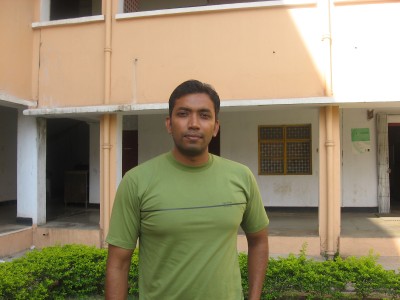
Guest blogger Madhan Muthu has a Masters in Library and Information Science, and has worked at the National Institute of Technology as an Assistant Librarian since March 2004. He is heavily involved as a volunteer in India's open access movement. Presently, he is coordinating the Oriya Books Digitisation project in partnership with other libraries. Prior to NIT, he was at the M S Swaminathan Research Foundation (MSSRF), Chennai, for about six years.
Author

